
Introduction
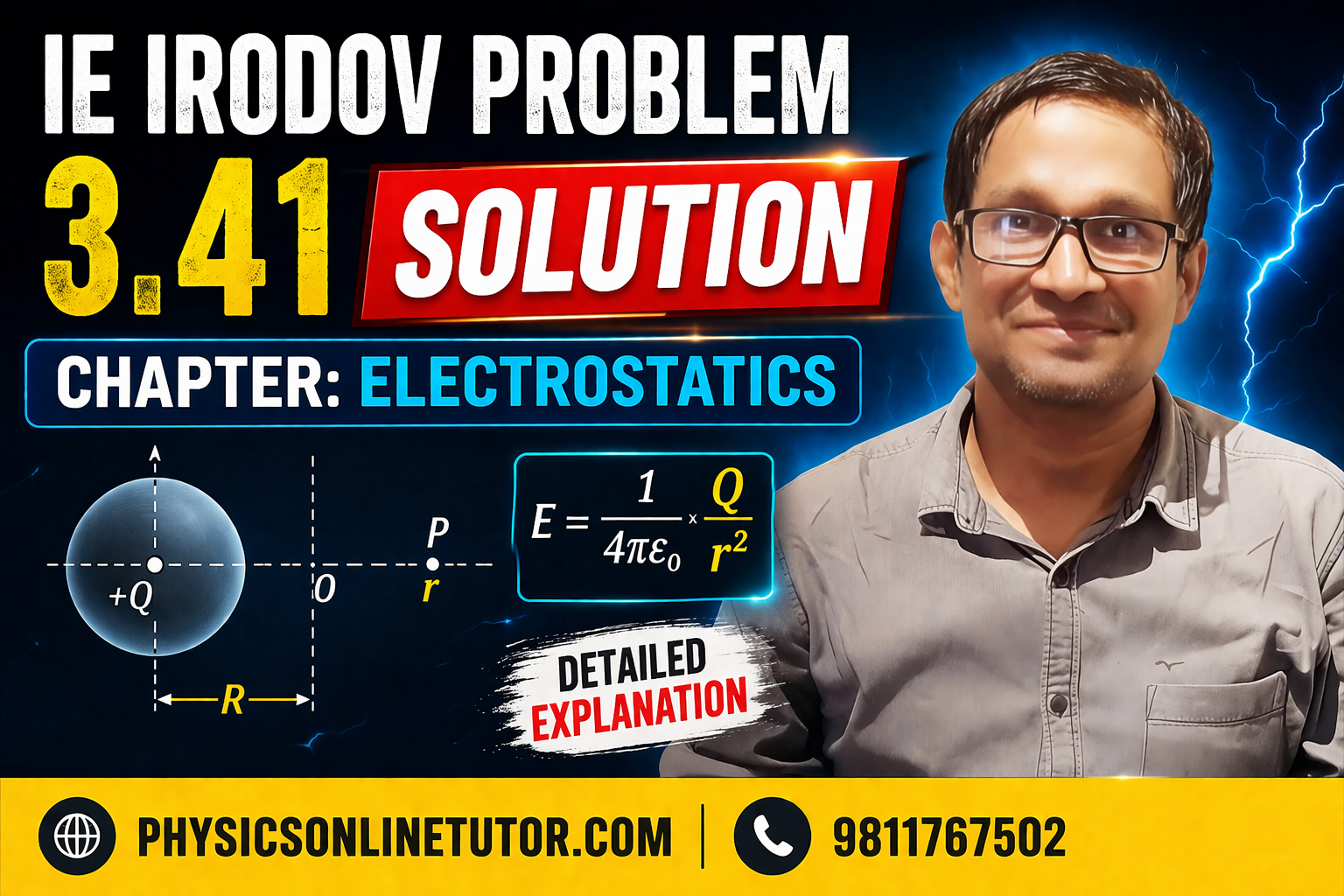
Preparing for JEE Advanced requires strong conceptual clarity, and solving problems from I.E. Irodov is one of the best ways to achieve that. In this article, we provide a complete solution to I.E. Irodov Problem 3.41 from Electrostatics with a step-by-step explanation.
This problem focuses on the relationship between electric potential, electric field, and motion of a charged particle, making it highly important for exam preparation.
Concepts Required
To solve I.E. Irodov Problem 3.41, you must understand:
- Electric field and potential relation
- Motion of charged particles
- Energy conservation in electrostatics
The key formula used is:
E=−dzdV
This equation shows that the electric field is the negative gradient of potential.
Step-by-Step Solution
Step 1: Analyze the Potential Function
The potential is given as a function of position along the z-axis:V(z)=f(z)
This function determines how the electric field varies in space.
Step 2: Find the Electric Field
Differentiate the potential:E(z)=−dzdV
This gives the electric field acting on the particle.
Step 3: Force on the Particle
The force acting on a charge q is:F=qE
This determines the acceleration of the particle.
Step 4: Apply Energy Conservation
Since the particle starts from rest:
qV(z0)=qV(z)+21mv2
This equation helps us find velocity at any point.
Step 5: Determine Turning Point
At maximum displacement:v=0
So,V(z0)=V(zmax)
Solve this equation to find the turning point.
Final Result
- The particle moves under the influence of a non-uniform electric field
- Its motion is best analyzed using energy conservation
- The turning point is obtained when kinetic energy becomes zero
Important Tips
- Always include the negative sign in E=−dV/dz
- Use energy methods instead of force when possible
- Carefully apply initial conditions
Why This Problem Matters
- Frequently relevant for JEE Advanced level questions
- Strengthens concepts of electric potential and motion
- Improves analytical problem-solving skills
Conclusion
The I.E. Irodov Problem 3.41 solution is a great example of how multiple electrostatics concepts come together. By mastering this, you’ll be better prepared for advanced physics problems.
Call to Action
📞 Contact: 9811767502
🌐 Website: physicsonlinetutor.com
Get expert guidance for JEE Advanced Physics preparation.