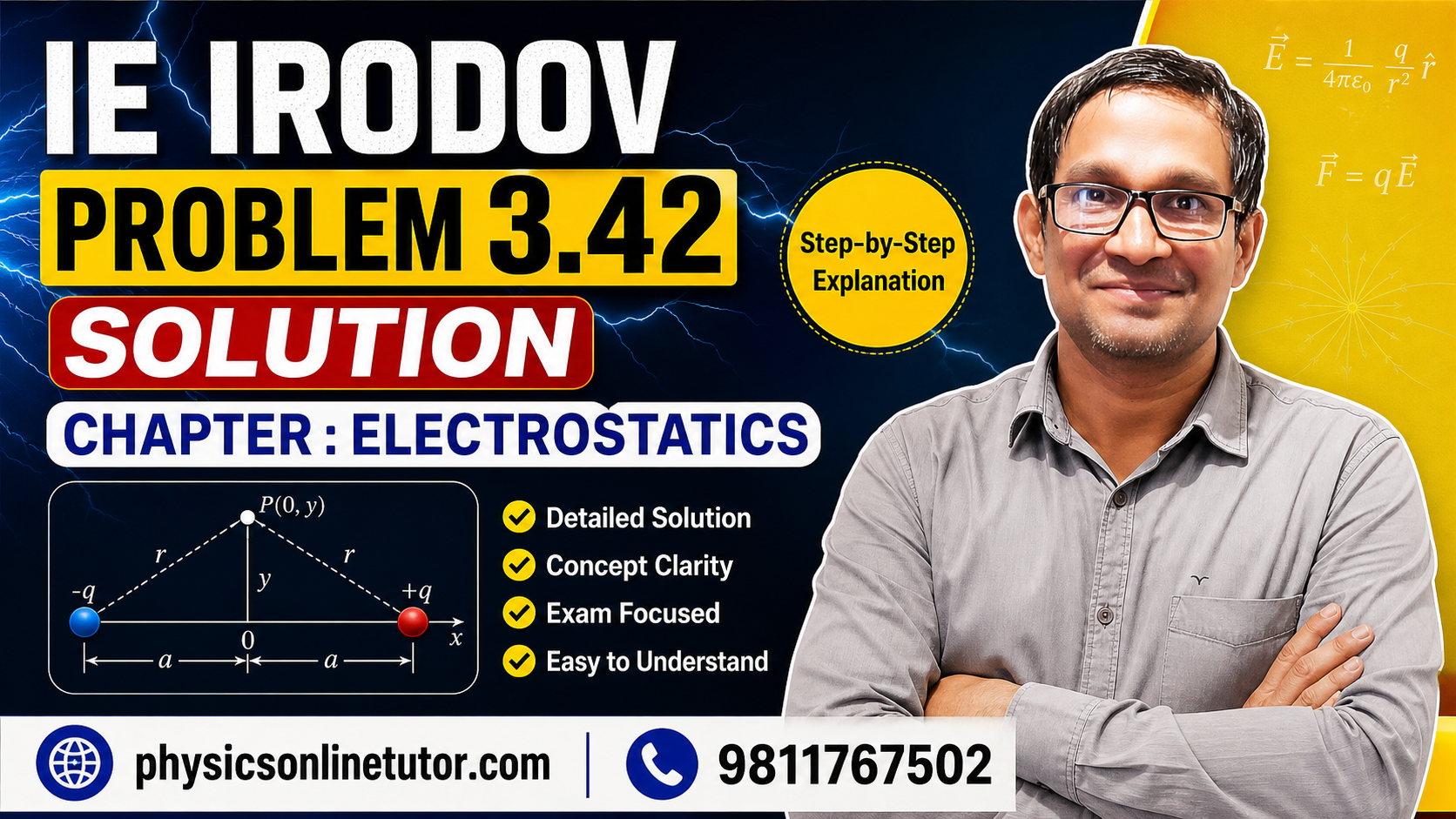

Introduction to Irodov Problem 3.42 Solution: Electrostatics Problems
If you're preparing for competitive exams like JEE Advanced or NEET, solving problems from I.E. Irodov is one of the best ways to strengthen your physics concepts. In this article, we will discuss the I.E. Irodov Problem 3.42 Solution from Electrostatics Problems, highlighting the Irodov Electrostatics Solution for JEE Advanced Physics Electrostatics in a clear and structured way.
This problem is particularly important because it tests your understanding of electric field, symmetry, and vector addition of forces—all core concepts in electrostatics.
This problem is an excellent example of Electric Field Problems that require a solid grasp of the underlying principles.
Problem Overview
Irodov Problem 3.42 Solution: Key Insights into Electrostatics Problems
Irodov Problem 3.42 Solution: Understanding Electric Field Problems
In I.E. Irodov Problem 3.42, you are typically required to analyze a system involving charges placed symmetrically and determine the resultant electric field or force at a specific point.
This analysis of the Irodov Electrostatics Solution is crucial for mastering the principles of Electric Field Problems, especially for JEE Advanced Physics Electrostatics.
The problem focuses on:
Understanding charge distribution
Applying Coulomb’s Law
Resolving vector components
Key Concepts Used
Before jumping into the solution, let’s revise the important concepts involved:
- Coulomb’s Law
The force between two point charges is given by:
F=
4πϵ
0
1
⋅
r
2
q
1
q
2
- Electric Field Due to a Point Charge
E=
4πϵ
0
1
⋅
r
2
q
- Principle of Superposition
The net electric field is the vector sum of fields due to all charges.
- Symmetry in Electrostatics
Symmetry helps simplify calculations by canceling components of electric fields.
Step-by-Step Solution
Let’s break down the solution in a simple and exam-oriented way.
Step 1: Understand the Geometry
Identify the position of charges and the point where the electric field is to be calculated. Most Irodov problems use symmetrical arrangements, which is the key to simplifying the solution.
Step 2: Calculate Distance
Find the distance between each charge and the point of interest using geometry.
Step 3: Calculate Electric Field Due to Each Charge
Apply the formula:
E=
r
2
kq
where k=
4πϵ
0
1
Step 4: Resolve Components
Break each electric field into:
Horizontal component (Ex)
Vertical component (Ey)
Step 5: Apply Symmetry
In many cases:
Horizontal components cancel out
Vertical components add up
This step significantly reduces calculation complexity.
Step 6: Add Resultant Electric Field
Combine all components to get the final electric field:
E
net
=
E
x
2
+E
y
2
Final Result
After solving carefully, you will obtain the magnitude and direction of the electric field at the required point.
👉 The key takeaway is that symmetry simplifies the problem drastically, making it easier to solve even complex-looking questions.
Common Mistakes to Avoid
🚫 Ignoring symmetry in the problem
🚫 Not resolving vector components properly
🚫 Using incorrect distance values
🚫 Forgetting direction of electric field
Avoiding these mistakes can improve both accuracy and speed.
Exam Tips for JEE Advanced
✔ Always look for symmetry first
✔ Draw a clear diagram before solving
✔ Practice vector resolution regularly
✔ Focus on conceptual clarity rather than memorization
Why Practice I.E. Irodov Problems?
I.E. Irodov problems are known for their depth and quality. Practicing them helps you:
Build strong fundamentals
Improve analytical thinking
Prepare for high-level exams like JEE Advanced
Gain confidence in solving tricky problems
Watch the Full Video Solution
For a detailed visual explanation, watch the complete solution here:
🎥 I.E. Irodov Problem 3.42 Solution | Electrostatics
About Physics Online Tutor
If you want to master physics with expert guidance, visit:
🌐 physicsonlinetutor.com
📞 9811767502
Get personalized coaching for:
JEE Advanced
NEET
Class 11 & 12 Physics
Conclusion
The I.E. Irodov Problem 3.42 Solution is a perfect example of how conceptual clarity and symmetry can make complex electrostatics problems easy to solve.
By practicing such problems regularly, you will not only improve your problem-solving skills but also gain confidence for competitive exams.