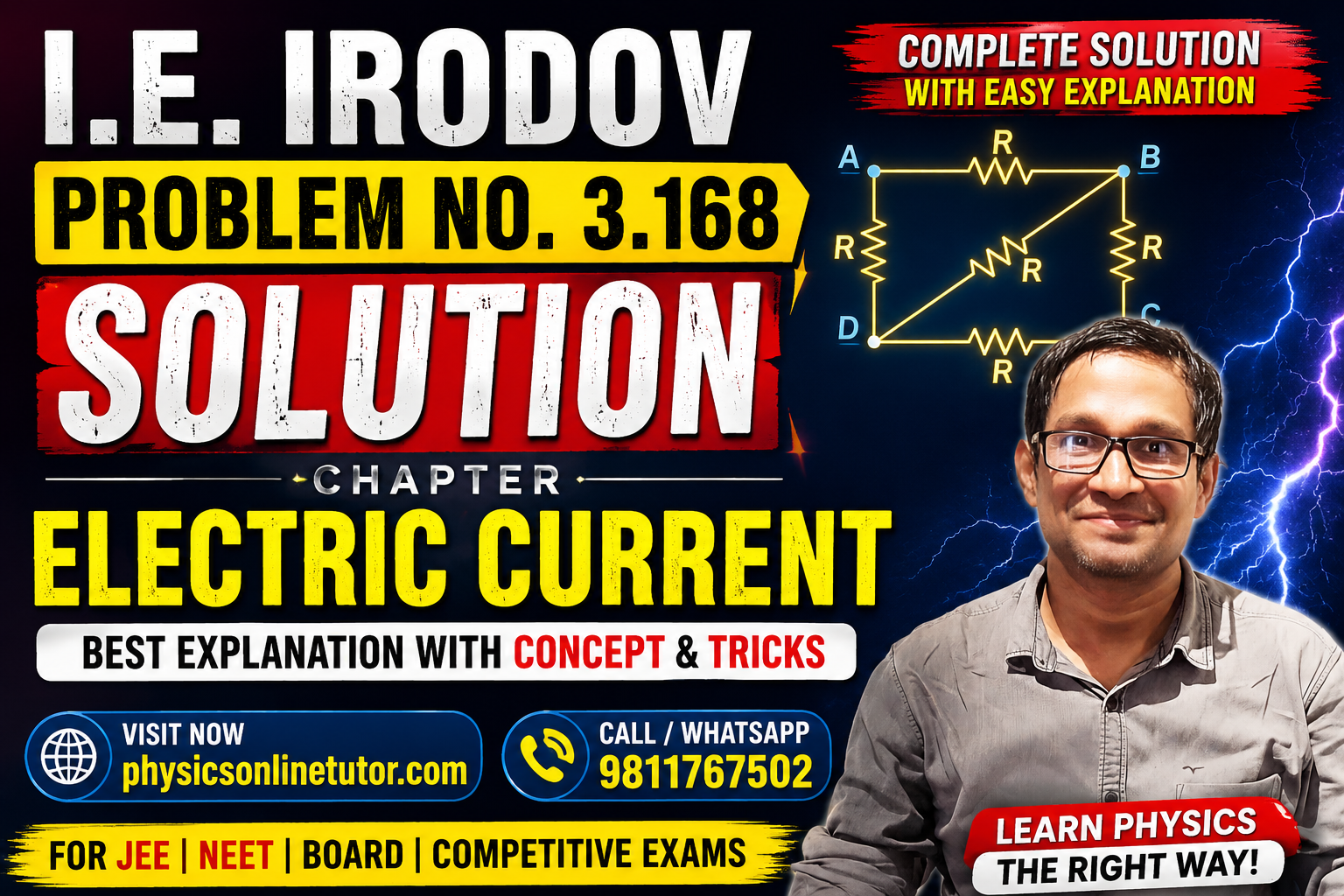

I.E. Irodov Problem No. 3.168 Solution is an excellent problem for students preparing for JEE Advanced, NEET, Physics Olympiads, and other competitive examinations. This problem tests your understanding of electric current, resistance networks, circuit analysis, and logical problem-solving techniques.
In this article, we will discuss the concepts involved in solving I.E. Irodov Problem No. 3.168 and explain the strategy required to approach similar high-level physics problems. Rather than relying on shortcuts, this explanation focuses on developing a deep conceptual understanding that helps students solve a wide range of electrical circuit questions.
Why Study I.E. Irodov Problems?
The Problems in General Physics by I.E. Irodov is considered one of the best books for strengthening analytical thinking in physics. The problems are designed to improve conceptual clarity rather than memorization.
Benefits of practicing I.E. Irodov include:
- Develop strong analytical skills.
- Improve logical thinking.
- Strengthen mathematical application in physics.
- Enhance confidence for JEE Advanced.
- Prepare effectively for Physics Olympiads.
- Gain mastery over Electric Current concepts.
Concepts Required for Problem No. 3.168
Before attempting I.E. Irodov Problem No. 3.168 Solution, students should have a clear understanding of the following topics:
- Electric Current
- Ohm's Law
- Resistance
- Equivalent Resistance
- Current Distribution
- Potential Difference
- Kirchhoff's Current Law (KCL)
- Kirchhoff's Voltage Law (KVL)
- Symmetry in Electrical Networks
- Series and Parallel Combination of Resistors
A solid understanding of these concepts makes solving advanced resistance network problems much easier.
Problem-Solving Strategy
Instead of jumping directly into lengthy calculations, always begin by carefully examining the structure of the electrical circuit.
A systematic approach includes:
Step 1: Observe Circuit Symmetry
Many I.E. Irodov resistance problems involve hidden symmetry. Identifying symmetry often simplifies the circuit significantly.
Step 2: Identify Equivalent Resistance
Replace obvious series and parallel combinations wherever possible before applying Kirchhoff's laws.
Step 3: Apply Kirchhoff's Laws
Use:
- Kirchhoff's Current Law at junctions.
- Kirchhoff's Voltage Law in independent loops.
These equations allow systematic determination of unknown currents and voltages.
Step 4: Verify Physical Meaning
After obtaining the answer, always check whether:
- Current directions are reasonable.
- Potential differences satisfy Ohm's Law.
- Units are correct.
- The final result is physically meaningful.
Common Mistakes Students Make
While solving I.E. Irodov Problem No. 3.168, many students commit avoidable errors.
Some common mistakes include:
- Ignoring symmetry.
- Incorrectly combining resistors.
- Wrong current direction assumptions.
- Sign mistakes while applying Kirchhoff's Voltage Law.
- Skipping intermediate calculations.
- Not verifying the final answer.
Avoiding these mistakes can save valuable time during competitive examinations.
How This Problem Helps in JEE Advanced
JEE Advanced is famous for testing conceptual understanding rather than formula memorization.
Problems like I.E. Irodov Problem No. 3.168 Solution improve your ability to:
- Analyze unfamiliar circuits.
- Apply multiple concepts together.
- Develop logical reasoning.
- Improve calculation accuracy.
- Solve lengthy questions efficiently.
These are precisely the skills required to score high in JEE Advanced Physics.
Importance for NEET Aspirants
Although NEET generally asks comparatively simpler questions, practicing I.E. Irodov develops strong fundamentals.
Benefits include:
- Better conceptual clarity.
- Faster problem-solving speed.
- Improved confidence.
- Strong understanding of current electricity.
- Better performance in difficult numerical questions.
Tips to Solve Electric Current Problems Faster
Here are a few practical tips:
- Draw a neat circuit diagram.
- Label all currents clearly.
- Mark voltage drops carefully.
- Look for symmetry before calculations.
- Simplify the circuit step by step.
- Double-check every algebraic equation.
- Practice regularly instead of memorizing solutions.
Consistency is the key to mastering current electricity.
Learn Physics with Shivendra Sir
If you want to master Electric Current, Electrostatics, Magnetism, Modern Physics, and other important chapters for competitive exams, learning through concept-based teaching is essential.
Shivendra Sir has over 17 years of teaching experience and has helped numerous students achieve excellent results in:
- Class 11 Physics
- Class 12 Physics
- JEE Main
- JEE Advanced
- NEET
- Physics Olympiad
Classes focus on conceptual learning, problem-solving techniques, and exam-oriented preparation.
Join Our Physics Courses
We offer:
- Small Batch Classes
- One-to-One Online Tuition
- JEE Advanced Preparation
- NEET Physics
- Board Exam Preparation
- Crash Courses
- Regular Tests and Assignments
Website: https://physicsonlinetutor.com
Call / WhatsApp: 9811767502
Conclusion
The I.E. Irodov Problem No. 3.168 Solution is an excellent exercise for building a deep understanding of Electric Current and advanced circuit analysis. By focusing on symmetry, equivalent resistance, Kirchhoff's laws, and logical reasoning, students can confidently solve challenging numerical problems.
Regular practice of I.E. Irodov problems not only improves problem-solving speed but also strengthens conceptual foundations, making it easier to tackle questions in JEE Advanced, NEET, Physics Olympiads, and Board examinations.
If you're serious about excelling in Physics, practice one I.E. Irodov problem every day and analyze the underlying concepts—not just the final answer.