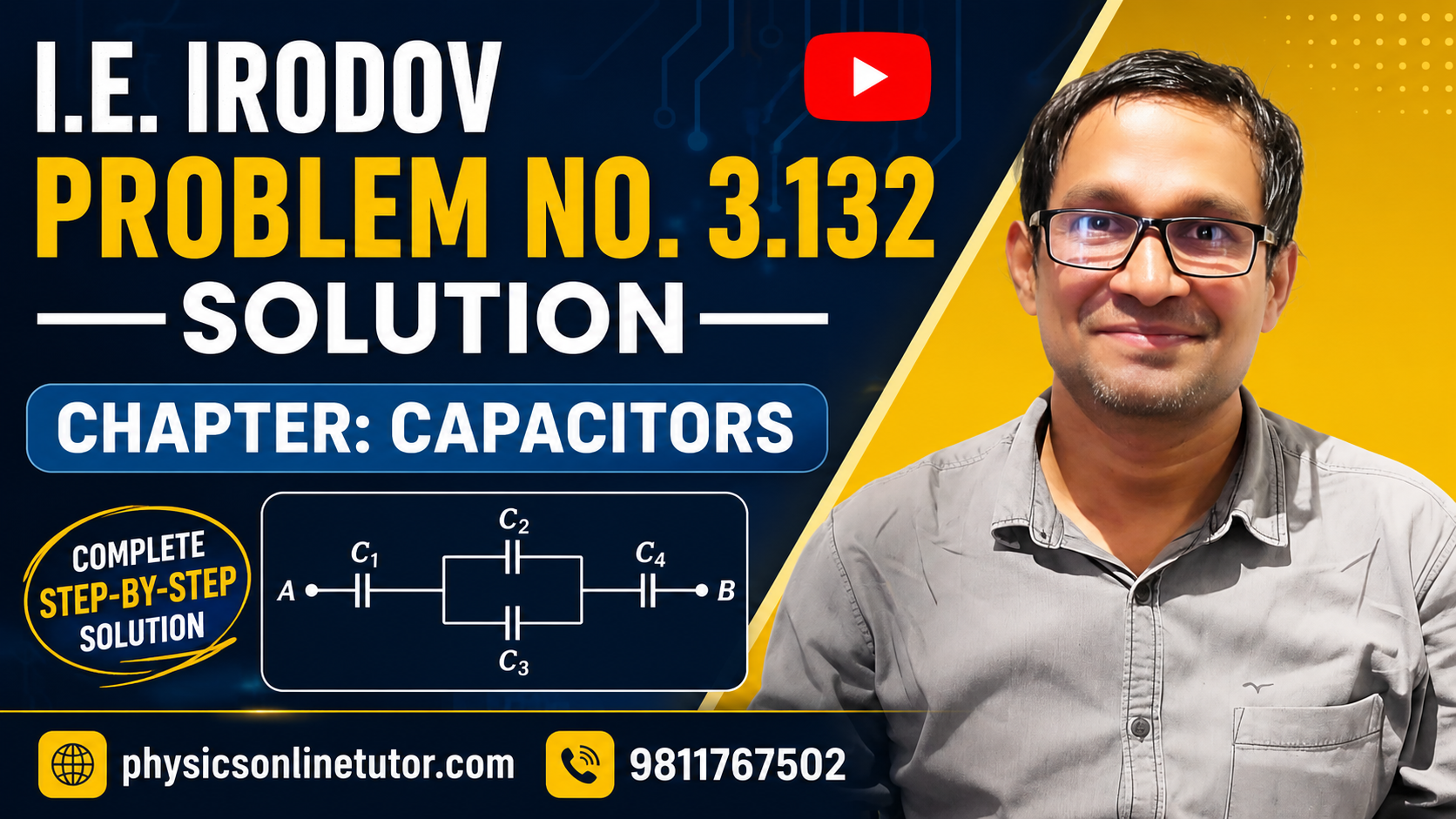

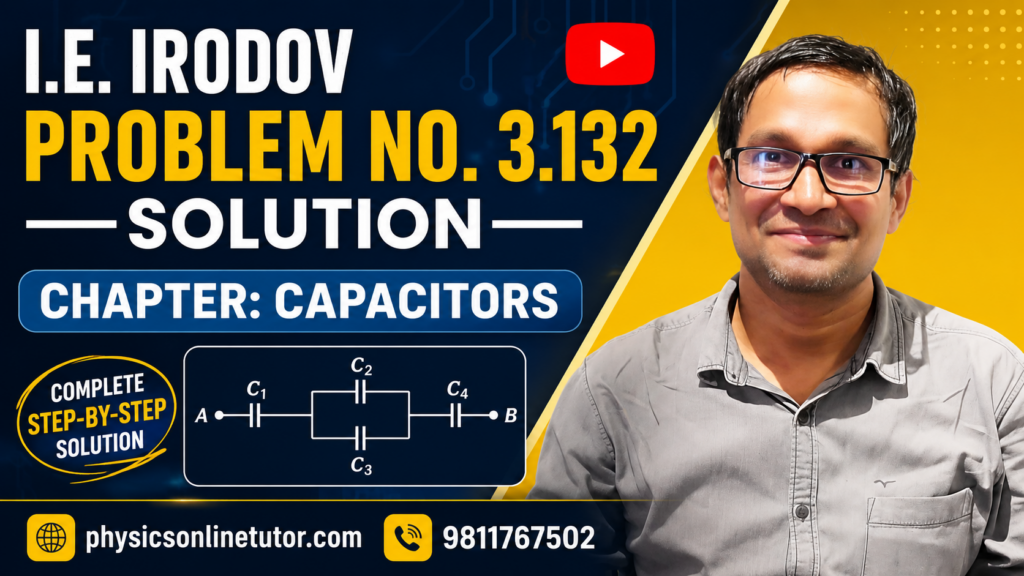
Preparing for IIT JEE Advanced requires more than memorizing formulas—it demands a deep understanding of concepts and the ability to solve challenging numerical problems. One of the best books for developing these skills is Problems in General Physics by I.E. Irodov. In this article, we present the I.E. Irodov Problem 3.132 Solution from the Capacitors chapter with a clear, systematic explanation. Whether you are an IIT JEE aspirant, a Physics Olympiad student, or someone passionate about mastering Electrostatics, this guide will help you understand the concepts behind capacitor combinations and network analysis. Why Solve I.E. Irodov Problems? The problems in I.E. Irodov are known for testing conceptual clarity and analytical thinking. Unlike routine textbook exercises, these questions require students to apply multiple physics concepts simultaneously. By regularly solving I.E. Irodov problems, students can: Develop advanced problem-solving skills. Strengthen conceptual understanding. Improve analytical thinking. Prepare effectively for IIT JEE Advanced and Olympiads. Build confidence in solving complex Physics questions. Problem No. 3.132 is an excellent example of how capacitor networks can be simplified using logical reasoning and fundamental principles. Concepts Required Before Solving Problem 3.132 Before attempting this problem, students should be comfortable with the following topics: Capacitance and its physical meaning. Series combination of capacitors. Parallel combination of capacitors. Equivalent capacitance calculations. Charge conservation. Potential difference across capacitors. Electrostatic energy stored in capacitors. If these concepts are clear, solving this problem becomes significantly easier. Step-by-Step Strategy for Solving I.E. Irodov Problem 3.132 Instead of jumping directly into calculations, follow this structured approach: Step 1: Observe the Circuit Carefully Study the capacitor network and identify which capacitors are connected in series and which are connected in parallel. Step 2: Simplify the Network Replace simple series and parallel combinations with their equivalent capacitance wherever possible. Step 3: Apply Capacitance Formulas Use the standard equations: For series: [ \frac{1}{C_{eq}}=\frac{1}{C_1}+\frac{1}{C_2}+... ] For parallel: [ C_{eq}=C_1+C_2+C_3 ] These formulas help reduce complicated networks into simpler equivalent circuits. Step 4: Determine Charge Distribution
Learn with Physics Online Tutor At PhysicsOnlineTutor.com, our objective is to simplify advanced Physics for every student. Every I.E. Irodov solution is explained with: Complete step-by-step derivations. Easy-to-understand diagrams. Concept-based explanations. IIT JEE Advanced approach. Shortcuts where applicable. Common mistakes explained clearly. These detailed explanations help students understand the reasoning behind every step instead of simply memorizing solutions. Watch the Complete Video Solution If you prefer visual learning, watch the complete video solution of I.E. Irodov Problem No. 3.132 on our YouTube channel. The video explains every calculation, circuit simplification, and concept in detail, making it easier to grasp even challenging capacitor networks. Visit: Website: https://physicsonlinetutor.com Contact: +91-9811767502 Final Thoughts The I.E. Irodov Problem 3.132 Solution is an excellent exercise for strengthening your understanding of capacitor networks and electrostatics. Rather than focusing only on obtaining the final answer, pay close attention to the reasoning behind each step. Developing this habit will improve your ability to tackle unfamiliar problems in IIT JEE Advanced, Olympiads, and other competitive examinations. Consistent practice, combined with conceptual clarity, is the key to mastering Physics. Continue solving I.E. Irodov problems regularly, review your mistakes, and build confidence through systematic learning. Good luck with your preparation, and keep exploring challenging Physics problems to sharpen your analytical skills!