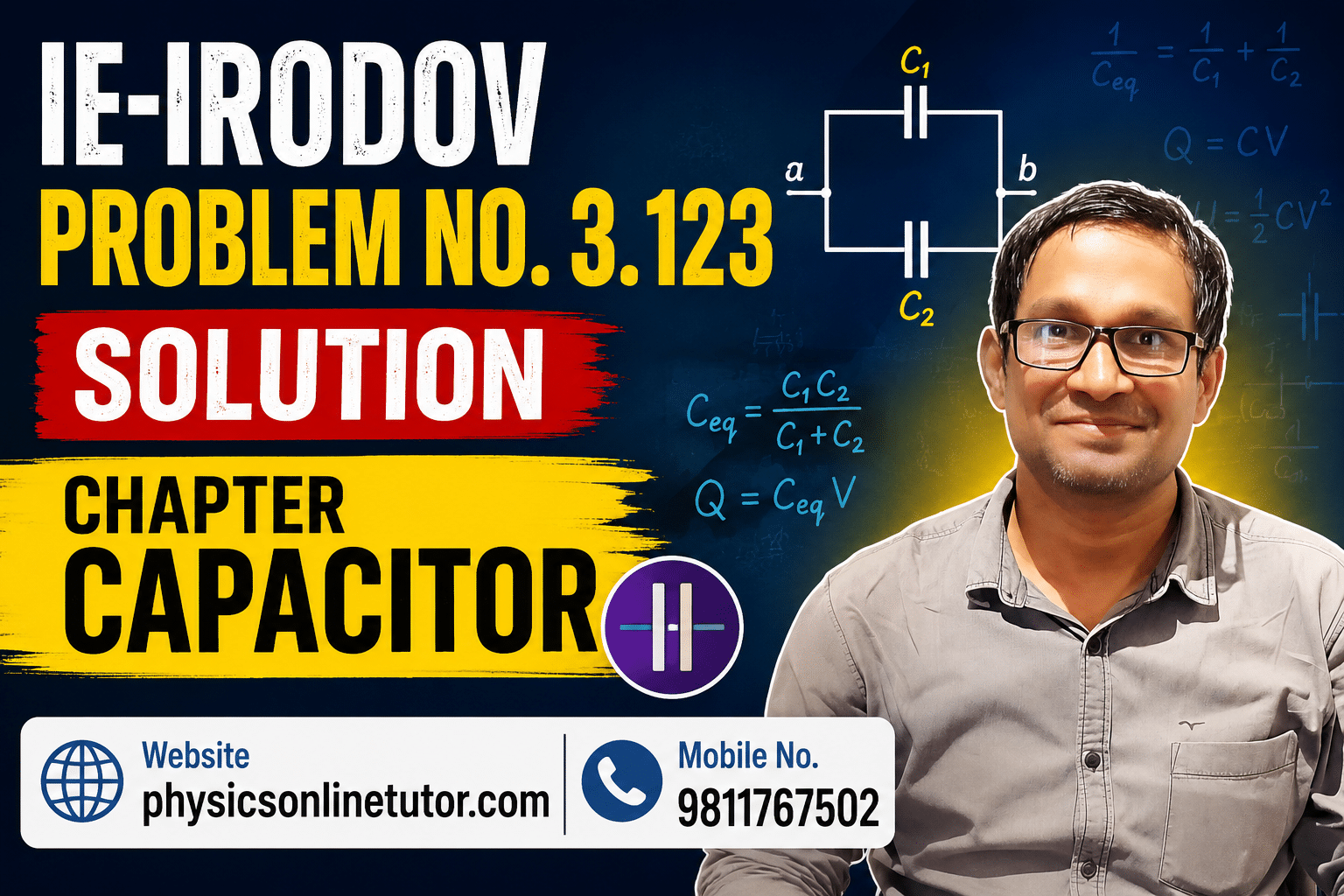

IE Irodov Problem No. 3.123 Solution is an important problem from the chapter Capacitors, a fundamental topic in electrostatics and one of the most frequently tested areas in competitive examinations such as IIT JEE Advanced, JEE Main, NEET, and Physics Olympiads. Students often find capacitor problems challenging because they require a clear understanding of charge distribution, potential difference, equivalent capacitance, and energy storage.
In this article, we discuss the concepts behind IE Irodov Problem No. 3.123 Solution, explain the theory of capacitors involved in the problem, and provide useful strategies for solving similar advanced-level questions. Understanding the Capacitor Chapter The chapter on capacitors is a cornerstone of electrostatics. A capacitor is an electrical device capable of storing electric charge and energy. It consists of two conductors separated by an insulating material called a dielectric. The basic relation governing a capacitor is: Q = CV where: Q = Charge stored C = Capacitance V = Potential difference Students preparing for IIT JEE and Olympiads must develop strong conceptual clarity regarding capacitor combinations, charge conservation, and energy calculations. Why IE Irodov Problems Are Important
The IE Irodov Problem No. 3.123 Solution is particularly useful because it combines multiple capacitor concepts into a single problem. Solving such questions improves: Conceptual understanding Analytical skills Problem-solving speed Confidence for competitive examinations Students who regularly practice Irodov problems often perform better in advanced physics examinations. Concepts Required for IE Irodov Problem No. 3.123 Solution Before attempting this problem, students should revise the following topics: 1. Equivalent Capacitance When capacitors are connected in series: 1/Ceq = 1/C1 + 1/C2 + ... When capacitors are connected in parallel: Ceq = C1 + C2 + ... Correct identification of series and parallel combinations is essential. 2. Charge Conservation In isolated capacitor systems, total charge remains conserved. Many advanced Irodov problems use this principle extensively. 3. Potential Difference The potential difference across capacitors determines charge distribution. Students should carefully analyze voltage conditions in every circuit.
These formulas frequently appear in advanced capacitor problems. Step-by-Step Approach to Solve IE Irodov Problem No. 3.123 Although every student should attempt the problem independently before viewing the complete solution, the following strategy can be used: Step 1: Draw the Circuit Clearly Redraw the capacitor network neatly. Label all capacitances, charges, and potentials. Step 2: Identify Symmetry Many Irodov capacitor problems contain hidden symmetry. Recognizing symmetry can significantly simplify calculations. Step 3: Determine Equivalent Capacitance Reduce the network step by step using series and parallel combinations whenever possible. Step 4: Apply Charge Conservation Use charge conservation equations to relate charges on different capacitors. Step 5: Calculate Required Quantity Depending on the question, determine: Charge Potential difference Equivalent capacitance Stored energy Electric field Step 6: Verify Units Always verify dimensional consistency before finalizing the answer. Common Mistakes Students Make While solving IE Irodov Problem No. 3.123 Solution, students often commit the following errors: Incorrect Series-Parallel Identification Many students mistakenly classify capacitor combinations. This leads to incorrect equivalent capacitance calculations. Ignoring Charge Conservation In disconnected capacitor systems, charge conservation is critical. Ignoring this principle can completely invalidate the solution. Sign Errors Potential differences and charge distributions must be assigned carefully with proper sign conventions. Formula Selection Errors Students frequently use incorrect energy formulas. Always verify which form is most suitable for the given problem. Exam Relevance The concepts used in IE Irodov Problem No. 3.123 Solution are highly relevant for: IIT JEE Advanced Questions involving capacitor networks, energy changes, and charge redistribution are common. JEE Main Direct applications of capacitance formulas and circuit simplification frequently appear. NEET Physics Although generally less difficult than Irodov, NEET includes conceptual capacitor questions requiring strong fundamentals. Physics Olympiads Olympiad-level physics often contains challenging capacitor arrangements similar to Irodov problems. Benefits of Practicing Irodov Capacitor Problems Regular practice offers several advantages: Improves conceptual understanding Enhances mathematical skills Builds confidence for advanced exams Develops logical thinking Strengthens electrostatics fundamentals Students should maintain a notebook of solved Irodov problems for quick revision before examinations. Learn Physics with Physics Online Tutor If you are preparing for IIT JEE, NEET, Physics Olympiads, or school examinations, personalized guidance can significantly improve your performance. At Physics Online Tutor, students receive: One-to-one physics coaching Doubt solving from I.E. Irodov IIT JEE Advanced preparation NEET Physics coaching Class 9–12 Physics support Numerical problem-solving sessions Concept-building lectures Website: physicsonlinetutor.com Mobile: 9811767502 Conclusion The IE Irodov Problem No. 3.123 Solution is an excellent exercise for mastering capacitor concepts and advanced problem-solving techniques. By understanding equivalent capacitance, charge conservation, potential difference, and energy storage, students can confidently tackle even the most challenging electrostatics questions. Consistent practice of Irodov problems not only strengthens fundamentals but also prepares students for IIT JEE Advanced, NEET, and Physics Olympiad examinations. Focus on conceptual clarity, follow a systematic approach, and regularly solve advanced numerical problems to achieve success in physics.