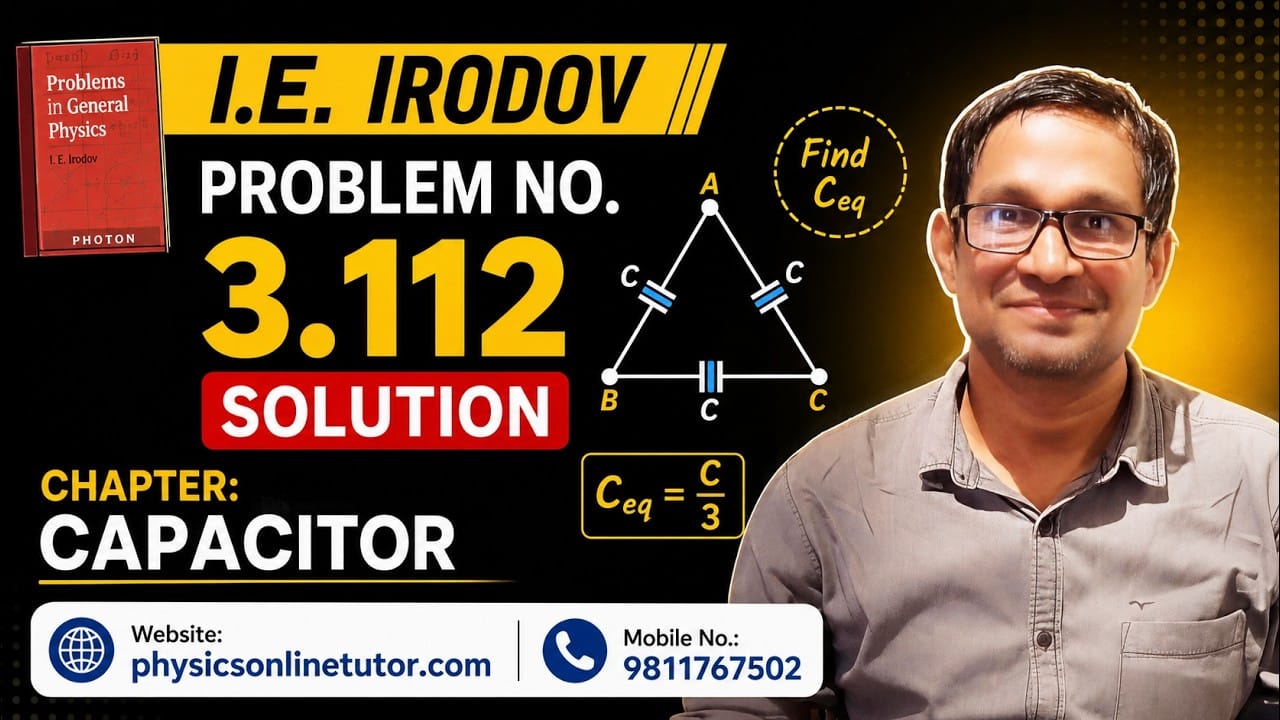

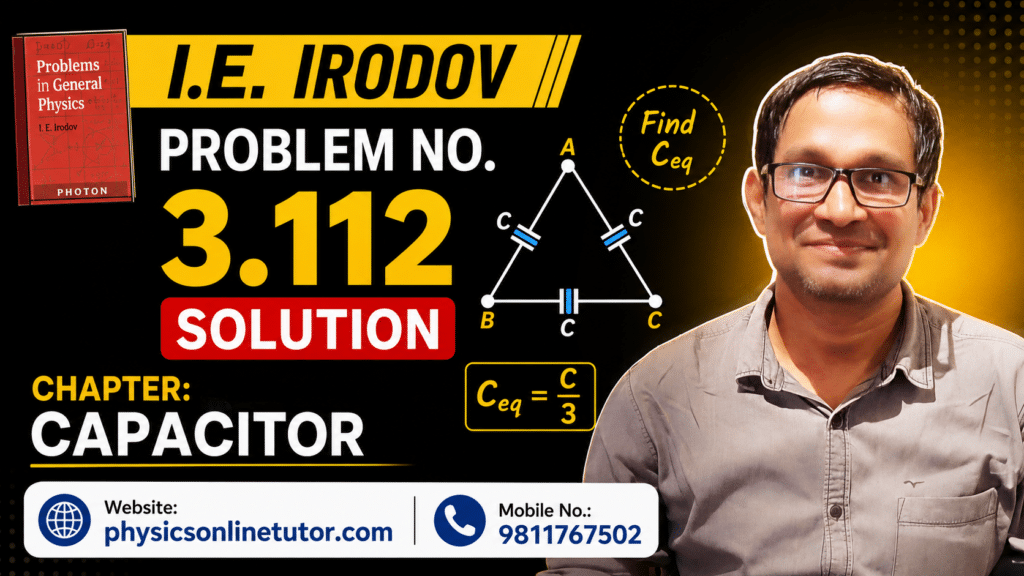
The chapter on Capacitors in I.E. Irodov's Problems in General Physics is considered one of the most important sections for students preparing for JEE Advanced, Olympiads, and other competitive examinations. Problem No. 3.112 is an excellent example that tests a student's understanding of capacitor combinations, symmetry, and equivalent capacitance concepts.
In this article, we discuss the key concepts involved in solving I.E. Irodov Problem No. 3.112 and explain why this problem is important for advanced-level physics preparation. Importance of Capacitors in Competitive Physics
Series and parallel combinations Equivalent capacitance calculations Energy stored in capacitors Charge distribution Symmetrical capacitor networks Potential difference calculations Students who master these topics gain a significant advantage in solving difficult JEE Advanced questions. Understanding the Concept Behind Problem No. 3.112 Problem 3.112 focuses on determining the equivalent capacitance of a capacitor arrangement. Such problems are designed to test conceptual clarity rather than direct formula application. The first step in solving these questions is identifying: The terminals across which equivalent capacitance is required. Capacitors connected in series. Capacitors connected in parallel. Symmetry present in the network. Potential differences across various branches. Many students make the mistake of immediately applying series and parallel formulas without carefully analyzing the circuit. I.E. Irodov problems often require a deeper understanding of charge conservation and electric potential. Fundamental Formulas Used Before attempting advanced capacitor problems, students should be comfortable with the following formulas: Capacitance [ C=\frac{Q}{V} ] where: C = Capacitance Q = Charge V = Potential Difference Capacitors in Series [ \frac{1}{C_{eq}}=\frac{1}{C_1}+\frac{1}{C_2}+\frac{1}{C_3} ] Capacitors in Parallel [ C_{eq}=C_1+C_2+C_3 ] Energy Stored [ U=\frac{1}{2}CV^2 ] These formulas provide the foundation for solving complex capacitor networks. Strategy for Solving I.E. Irodov Problem 3.112 A systematic approach is essential. Step 1: Examine Circuit Symmetry
No charge flows between them. Certain branches can be ignored. The circuit becomes significantly simpler. Step 2: Identify Equivalent Connections After exploiting symmetry, determine which capacitors are effectively in series or parallel. Students should redraw the circuit whenever necessary. A clean diagram often reveals hidden simplifications. Step 3: Apply Capacitance Rules Use series and parallel formulas carefully. Avoid combining capacitors too early. Ensure that the voltage relationships and charge conditions are correctly understood. Step 4: Calculate Final Equivalent Capacitance Once the network is reduced to a simple form, substitute the capacitor values and calculate the final answer. Common Mistakes Students Make While solving capacitor network problems, students frequently encounter the following issues: Ignoring Symmetry Many advanced problems become easy after identifying symmetrical points. Missing symmetry can lead to lengthy and complicated calculations. Incorrect Series-Parallel Identification Two capacitors are not necessarily in series simply because they are connected one after another. Always verify: Same charge condition for series. Same voltage condition for parallel. Calculation Errors Capacitor algebra can become lengthy. Maintain proper fractions and simplify carefully. Memorizing Instead of Understanding I.E. Irodov problems reward conceptual understanding rather than formula memorization. How This Problem Helps in JEE Advanced Preparation Problem No. 3.112 develops several critical skills: Circuit visualization Logical reasoning Symmetry analysis Electrostatics concepts Mathematical accuracy
Many advanced examination questions are inspired by the same principles tested in I.E. Irodov. Tips for Mastering Capacitor Problems Practice Daily Solve at least 3–5 capacitor problems every day. Draw Clean Diagrams Redrawing complicated networks often reveals shortcuts. Focus on Concepts Understand why capacitors are in series or parallel rather than memorizing patterns. Revise Electrostatics Strong fundamentals in electric potential and electric field make capacitor problems much easier. Solve Standard Books Recommended books include: I.E. Irodov H.C. Verma D.C. Pandey Cengage Physics Pathfinder for Olympiads Learn Advanced Physics with Physics Online Tutor At Physics Online Tutor, students receive expert guidance for: IIT JEE Main & Advanced NEET Physics Physics Olympiads Class 9–12 Physics Advanced Problem Solving Doubt Solving from I.E. Irodov, H.C. Verma, D.C. Pandey and NCERT With over 17 years of teaching experience, students learn concept-based problem-solving methods that help them excel in competitive examinations. Contact Information Website: physicsonlinetutor.com Mobile: 9811767502 Conclusion I.E. Irodov Problem No. 3.112 is an excellent capacitor-network problem that strengthens conceptual understanding of equivalent capacitance and circuit symmetry. By carefully analyzing the arrangement, identifying symmetrical points, and applying capacitor combination rules, students can solve the problem efficiently. Regular practice of such problems develops the advanced analytical skills required for JEE Advanced, NEET, and Physics Olympiad examinations. Mastering capacitor networks today will significantly improve your performance in future competitive exams.