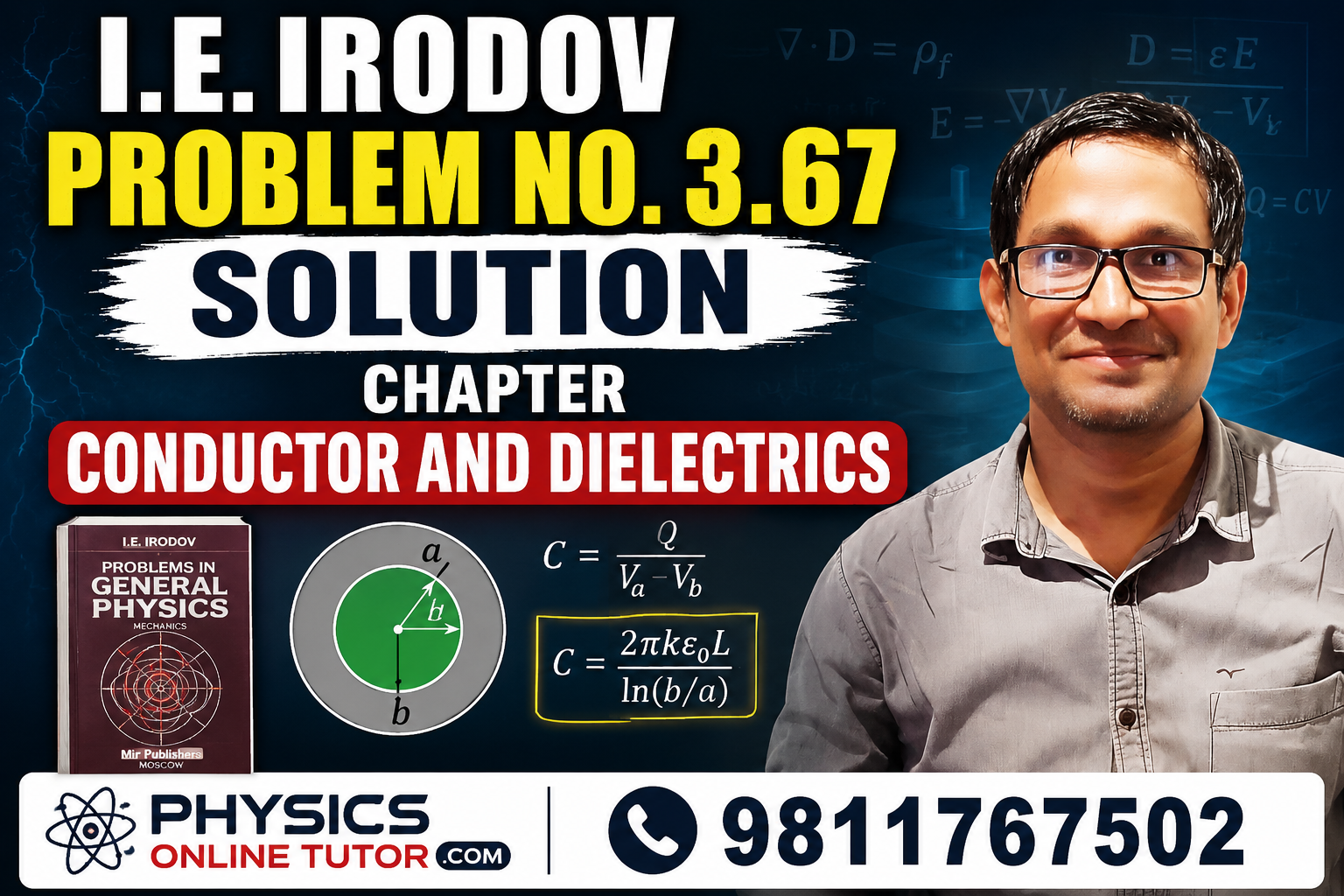

The chapter Conductors and Dielectrics in I.E. Irodov’s Problems in General Physics is famous for blending electrostatic theory with mathematically rigorous problem solving. Problem No. 3.67 is a classic example: students must apply the relationship between electric field, potential difference, and capacitance in a carefully chosen geometry. Rather than memorizing a formula, the key is to derive it from first principles. This article explains the physics intuition, the derivation strategy, common mistakes, and the exam-oriented takeaways that matter for IIT JEE Advanced, NEET Physics, and Olympiad preparation. What this problem is really testing Correct use of Gauss’s law or symmetry arguments. Ability to express electric field as a function of position. Computing potential difference by integration rather than using a memorized result. Using the definition capacitance = charge / potential difference. Handling dielectric or conductor boundaries consistently. Core Electrostatics Idea For many conductor–dielectric configurations in Irodov, the electric field is not uniform. The general workflow is: Determine the field E(r) using symmetry and Gauss’s law. Find the potential difference between two conductors: ΔV=−∫E⋅dl Use C= ΔV Q to obtain the capacitance. For cylindrical or coaxial geometries (a frequent setting in this chapter), the field typically varies as 1/r , so the potential difference produces a logarithm after integration. The Key Formula That Emerges When the geometry is that of a long coaxial system with inner radius a, outer radius b, and dielectric permittivity ε, the standard derivation gives: C= ln(b/a) 2πεL where L is the length of the capacitor. This is not a formula to memorize blindly. The logarithm appears because: \Delta V = \int_a^b \frac{\lambda}{2\pi \varepsilon r}\,dr = \frac{\lambda}{2\pi \varepsilon}\ln\!\left(\frac{b}{a} ight) and then Q=λL leads directly to the capacitance expression above. Step-by-Step Solution Strategy for Problem 3.67 Identify the conducting surfaces. Mark the inner and outer conductors and note the region where the electric field exists. Choose a Gaussian surface consistent with symmetry. For cylindrical symmetry, use a coaxial cylindrical surface of radius r and length L. Apply Gauss’s law. E(2πrL)= ε Q extenc Hence E(r)= 2πεr λ with λ=Q/L. Integrate to obtain the potential difference. V_a-V_b=\int_a^b E(r)\,dr = \frac{\lambda}{2\pi \varepsilon}\ln\!\left(\frac{b}{a} ight) Use the definition of capacitance. C= V a −V b Q = λln(b/a)/(2πε) λL which simplifies to C= ln(b/a) 2πεL Insert the appropriate permittivity. If a dielectric fills the region completely, use ε=ε 0 ε r . If the region contains multiple dielectrics, treat the configuration piecewise and combine the equivalent capacitances according to the geometry. Exam tip In JEE Advanced questions, students often lose marks by writing the coaxial-capacitance formula directly. Examiners frequently expect the field derivation + integration step, especially when the dielectric arrangement is modified from the standard textbook case. Common Mistakes Mistake Why it is wrong Using a uniform-field formula C=εA/d The field in cylindrical geometry varies as 1/r. Forgetting the logarithm The potential difference comes from integrating 1/r. Using ε 0 instead of ε 0 ε r A dielectric changes the permittivity of the medium. Integrating with reversed limits without handling the sign Potential difference is path-sensitive in sign conventions. Ignoring the assumption L≫b for ideal coaxial behavior End effects are neglected in the standard derivation. Why This Problem Matters for JEE Advanced Problem 3.67 is valuable because it connects Gauss’s law, potential integration, and capacitance definitions into one coherent argument. This pattern appears repeatedly in advanced electrostatics questions. If you can derive the result under time pressure, you are better prepared for: coaxial capacitors, cylindrical charge distributions, piecewise dielectric media, energy stored in non-uniform electric fields, field–potential conversion problems. Quick Revision Sheet Memorize the method, not just the formula: 1. E(r)=λ/(2πεr) 2. ΔV=(λ/(2πε))ln(b/a) 3. C=Q/ΔV 4. Final result: C=2πεL/ln(b/a) Conclusion I.E. Irodov Problem No. 3.67 from Conductors and Dielectrics is best approached through first-principles electrostatics: derive the field, integrate for potential difference, and then compute capacitance. The resulting logarithmic expression is a consequence of the 1/r dependence of the electric field in cylindrical symmetry, not a disconnected formula to memorize. Students preparing for IIT JEE Advanced, NEET, Olympiads, and other competitive exams should practice this derivation until each step feels natural. Once the field-to-potential-to-capacitance chain becomes automatic, a large class of advanced electrostatics problems becomes significantly easier to solve.