
Introduction
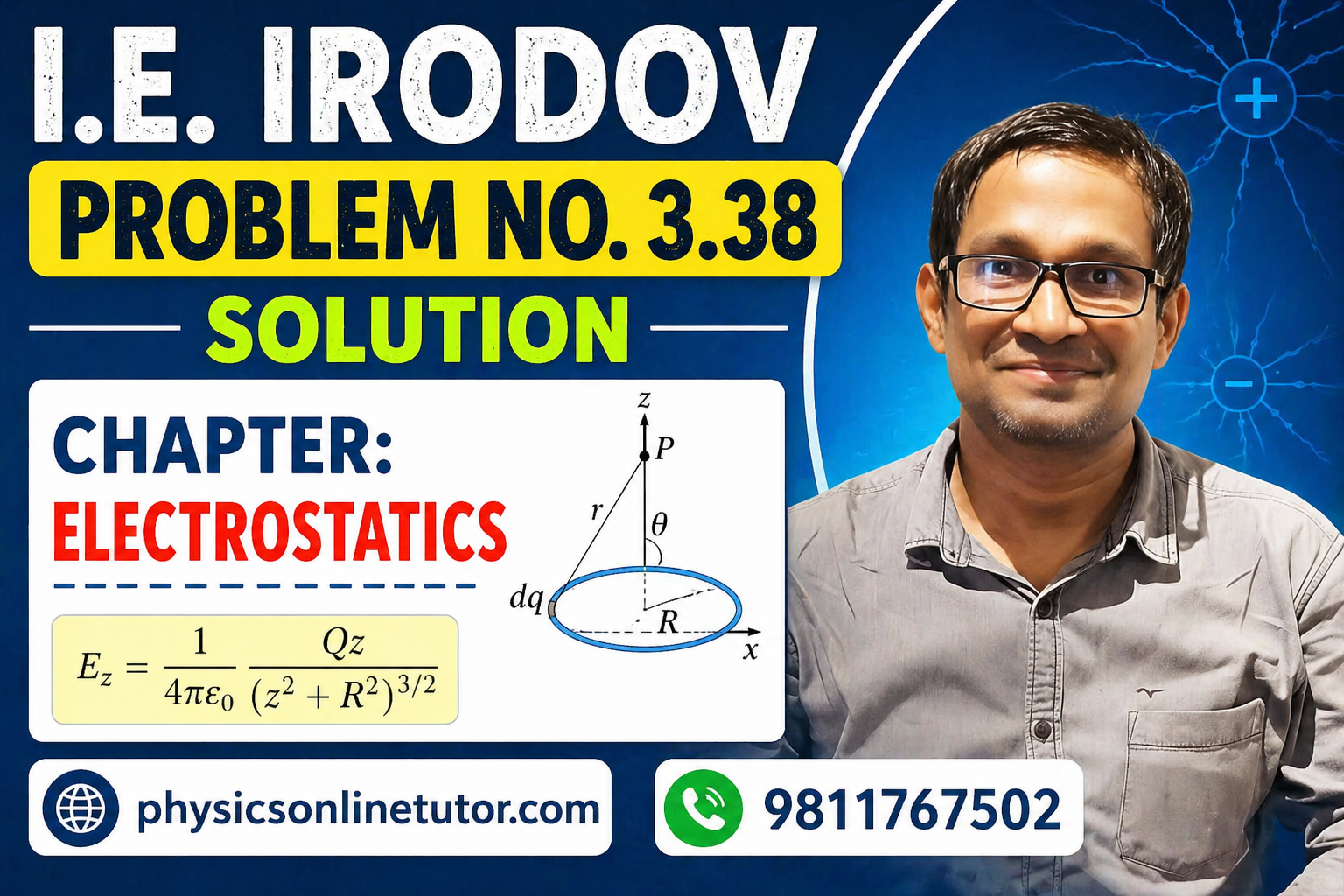
Preparing for competitive exams like JEE Advanced and NEET requires strong problem-solving skills, especially in Physics. One of the best books to develop these skills is I.E. Irodov. In this article, we will cover the I.E. Irodov Problem No. 3.38 Solution from the chapter Electrostatics in a detailed and easy-to-understand way.
This problem is important because it strengthens your understanding of electric field concepts and symmetry.
Problem Overview
The I.E. Irodov Problem No. 3.38 Solution focuses on electrostatics concepts such as electric field due to charge distribution and application of symmetry.
To solve this problem effectively, you must:
- Understand the geometry of the system
- Apply Coulomb’s law correctly
- Use symmetry to simplify calculations
Key Concepts Used
1. Electric Field Due to Charge Element
dE=4πϵ01r2dq
This formula gives the electric field contribution due to a small charge element.
2. Principle of Superposition
The net electric field is the vector sum of electric fields due to all charge elements.
3. Use of Symmetry
Symmetry plays a crucial role in simplifying complex electrostatics problems. It helps eliminate unnecessary components of the electric field.
Step-by-Step Solution of I.E. Irodov Problem No. 3.38
Step 1: Analyze the Given System
Start by carefully examining the charge distribution and identifying symmetry. Draw a diagram if needed.
Step 2: Consider a Small Charge Element
Take an infinitesimal charge element dq. The contribution of this element to the electric field is calculated using Coulomb’s law.
Step 3: Resolve Components
Resolve the electric field into components. Due to symmetry:
- Horizontal components cancel out
- Only vertical components contribute
Step 4: Integrate Over the Entire Distribution
E=∫dE
Substitute dq in terms of charge density and integrate over the entire distribution.
Step 5: Final Expression
After integration, simplify the expression to get the final electric field. Always check:
- Units
- Direction
- Limiting cases
Common Mistakes to Avoid
While solving I.E. Irodov Problem No. 3.38 Solution, students often make these errors:
- Ignoring symmetry
- Incorrect vector direction
- Mistakes in integration
- Not checking final units
Why This Problem is Important
The I.E. Irodov Problem No. 3.38 Solution helps you:
- Build strong electrostatics concepts
- Improve analytical thinking
- Prepare for high-level exams like JEE Advanced
Exam Preparation Tips
- Always draw diagrams
- Focus on symmetry
- Practice integration-based problems
- Revise formulas regularly
Learn Physics with Expert Guidance
If you want to master Physics and solve Irodov problems confidently:
🌐 Website: physicsonlinetutor.com
📞 Call/WhatsApp: 9811767502
We provide:
- Personalized coaching
- Test series and assignments
- Concept-based learning
Conclusion
In this article, we discussed the I.E. Irodov Problem No. 3.38 Solution in a structured and exam-oriented way. Understanding the method is more important than memorizing the answer.
Practice regularly and stay consistent to excel in Physics.