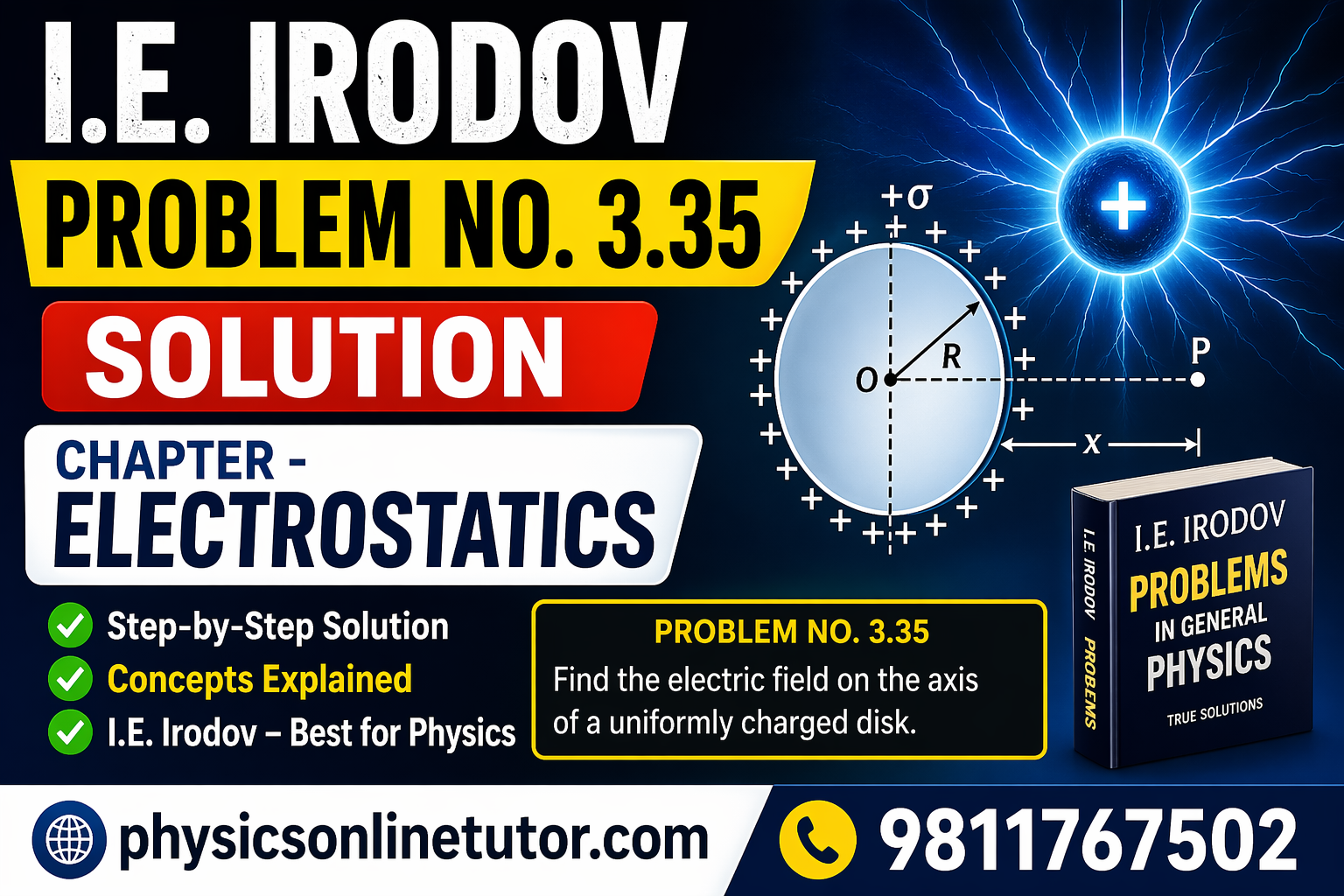


If you are preparing for advanced physics exams like JEE Advanced or олимпиad-level problems, then solving questions from Problems in General Physics by I.E. Irodov is almost a must. These problems are known for testing deep conceptual clarity, and Problem No. 3.35 from Electrostatics is a perfect example.
In this blog post, we will go through the I.E. IRODOV Problem No. 3.35 Solution Electrostatics step by step, understand the key concepts, and learn how symmetry plays a powerful role in simplifying calculations.
📘 Problem Statement (Irodov 3.35)
We are given a uniformly charged ring of radius R carrying a total charge Q. The task is to find the electric potential at a point on the axis of the ring, located at a distance x from its center.
🧠 Understanding the Concept
This problem is based on electric potential due to continuous charge distribution and uses two major ideas:
- Superposition Principle
- Symmetry of Charge Distribution
Unlike electric field, electric potential is a scalar quantity, which makes calculations much easier. We don’t need to resolve vectors—just add contributions directly.
⚙️ Step-by-Step Solution
Step 1: Consider a Small Charge Element
Let us take a small charge element dq on the ring.
The electric potential due to this small element at point P is:dV=4πε01⋅rdq
where r is the distance between dq and point P.
Step 2: Determine the Distance r
From geometry, every point on the ring is at the same distance from point P because of symmetry.
Using the Pythagorean relation:r=R2+x2
This is the key simplification — all charge elements are equidistant from point PPP.
Step 3: Substitute into Potential Expression
Now,dV=4πε01⋅R2+x2dq
Step 4: Integrate Over the Ring
To find total potential:V=∫dV=4πε0R2+x21∫dq
Since total charge on the ring is Q:∫dq=Q
✅ Final Answer:
V=4πε01⋅R2+x2Q
✨ Key Insights from This Problem
1. Symmetry Simplifies Everything
Because the ring is symmetric, every charge element contributes equally in terms of distance. This avoids complicated integration.
2. Scalar Nature of Potential
Unlike electric field, potential does not require vector addition. This makes such problems easier to handle.
3. Standard Result
This is a very important standard formula used in many advanced problems, including:
- Electric field derivation on axis of ring
- Disk and sphere potential problems
- Capacitor analysis
🎯 Why This Problem is Important for JEE Advanced
The I.E. IRODOV Problem No. 3.35 Solution Electrostatics is not just about solving one question. It builds a strong foundation for:
- Continuous charge distributions
- Use of symmetry in physics
- Integration-based derivations
- Advanced electrostatics modeling
In exams like JEE Advanced, similar concepts are often twisted into new problems. If you understand this deeply, you can solve many variations easily.
🚀 Pro Tips for Students
- Always check for symmetry before starting integration
- Prefer potential approach over electric field when possible
- Practice similar problems like:
- Potential due to a disk
- Field on axis of ring
- Charged rod problems
🧾 Conclusion
The I.E. IRODOV Problem 3.35 Solution beautifully demonstrates how powerful symmetry and basic electrostatics concepts can simplify what initially looks like a complex problem.
By understanding this solution, you not only master one problem but also gain a strategy to tackle many similar problems in electrostatics.
Keep practicing and try deriving the electric field on the axis of the ring as your next challenge—it’s a natural extension of this problem!