

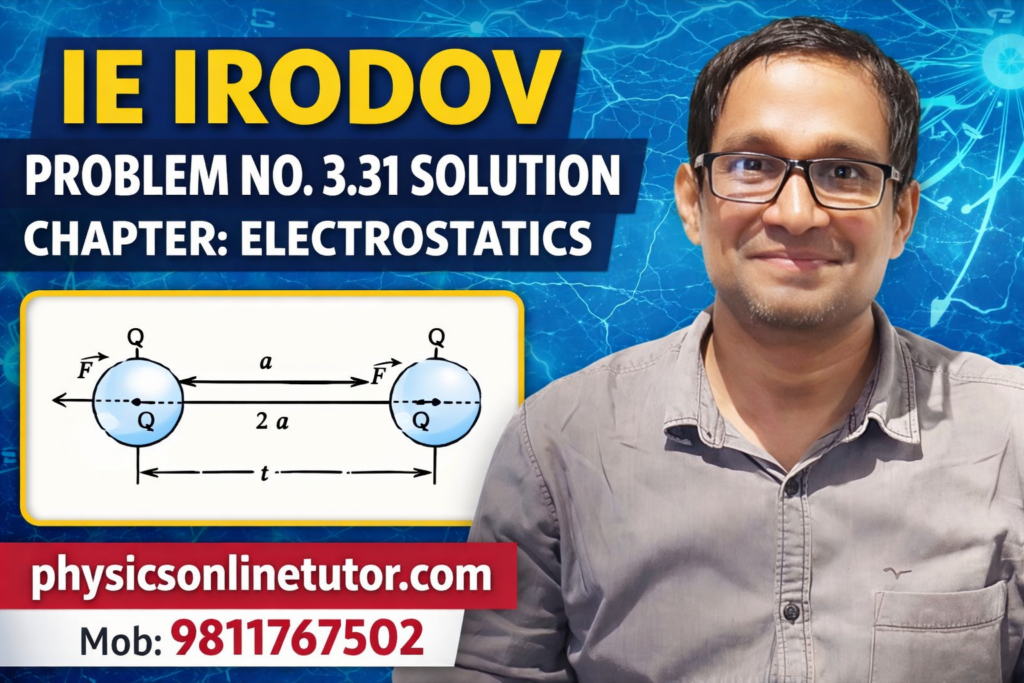
Introduction Electrostatics is one of the most fundamental and high-weightage topics in physics, especially for competitive exams like JEE Advanced and NEET. Among the best resources to master this subject is the classic problem book by I.E. Irodov. In this article, we will explore IE Irodov Problem No. 3.31 from the Electrostatics chapter and break it down into simple, understandable steps. This problem is an excellent example of how multiple concepts—such as Coulomb’s law, force interaction, and symmetry—come together in a single question. If you are aiming to strengthen your problem-solving skills, this detailed explanation will help you grasp both the concept and the method. Understanding the Problem Before jumping into calculations, it’s essential to carefully interpret the physical situation described in the problem. Typically, problems like 3.31 involve: Multiple charged bodies or spheres Forces acting due to electrostatic interactions Distances between charges that influence force magnitude Symmetry or motion considerations The key idea is to visualize the system clearly. Try to draw a diagram representing the charges, distances, and directions of forces. This step alone can simplify half the problem. Key Concepts Involved 1. Coulomb’s Law The fundamental principle governing electrostatic force is Coulomb’s law: F=k r 2 q 1 q 2 Where: F is the force between charges q 1 ,q 2 are the magnitudes of charges r is the distance between them k is Coulomb’s constant Understanding how force varies with distance is crucial for solving this problem. 2. Superposition Principle When multiple charges are present, the total force on any one charge is the vector sum of forces due to all other charges. This means: Consider each interaction separately Add forces vectorially (taking direction into account) 3. Symmetry in Charge Distribution Many Irodov problems cleverly use symmetry to simplify calculations. If the configuration is symmetric: Forces may cancel out in certain directions Net force may act along a specific axis Recognizing symmetry can save time and reduce complexity. Step-by-Step Solution Approach Let’s outline a structured method to solve IE Irodov Problem 3.31. Step 1: Draw the System Start by sketching: Positions of charges Distances between them Direction of forces A clear diagram helps avoid confusion later. Step 2: Identify Forces For each charge: Determine which other charges exert force on it Use Coulomb’s law to write expressions for these forces Pay attention to: Attractive vs repulsive forces Direction of each force vector Step 3: Resolve Forces Break forces into components if needed: Horizontal (x-axis) Vertical (y-axis) This is especially important if the charges are not aligned in a straight line. Step 4: Apply Superposition Add all force components: Combine x-components Combine y-components Then find the resultant force: F net = F x 2 +F y 2 Step 5: Use Symmetry (If Applicable) If the problem has symmetric placement: Opposing forces may cancel Only one direction may contribute to the net force This simplifies calculations significantly. Step 6: Final Answer After calculating the net force: Include correct units (Newtons) Mention direction if required Common Mistakes to Avoid While solving electrostatics problems, students often make these mistakes: Ignoring Direction of Force Electrostatic force is a vector quantity. Always consider direction. Incorrect Distance Calculation Ensure you are using the correct separation between charges. Forgetting Superposition Principle Never ignore contributions from any charge. Sign Errors Be careful with positive and negative charges. Skipping Diagram Not drawing a diagram often leads to confusion and errors. Why This Problem is Important IE Irodov Problem 3.31 is not just another numerical—it builds strong conceptual understanding. Here’s why it matters: Tests your ability to apply Coulomb’s law in multi-charge systems Enhances visualization skills Strengthens vector addition concepts Prepares you for advanced-level questions in exams Exam Relevance For students preparing for JEE Advanced, this type of problem is extremely important because: Questions often involve multiple interacting charges Conceptual clarity is tested more than formula memorization Time management becomes crucial Practicing such problems regularly will improve both speed and accuracy. Tips to Master Electrostatics If you want to excel in electrostatics, follow these tips: 1. Build Strong Basics Start with: Coulomb’s law Electric field Potential 2. Practice Regularly Solve a variety of problems: Easy → Medium → Difficult 3. Focus on Concepts Avoid rote learning. Understand: Why a formula works When to apply it 4. Analyze Mistakes After solving problems: Review incorrect answers Understand where you went wrong 5. Use Visualization Always draw diagrams for clarity. Conclusion IE Irodov Problem No. 3.31 is a powerful exercise to strengthen your understanding of electrostatics. By applying Coulomb’s law, using the superposition principle, and leveraging symmetry, you can solve even complex problems with confidence. Consistent practice and a structured approach are the keys to mastering such questions. Whether you are preparing for JEE Advanced or simply aiming to improve your physics skills, working through problems like this will significantly enhance your conceptual clarity. Call to Action For more such detailed physics solutions and guidance: 🌐 Visit: physicsonlinetutor.com 📞 Contact: 9811767502 👨🏫 Learn with Shivendra Sir – Expert Physics Faculty