
Cracking JEE Advanced: A Deep Dive into Electrostatics (2022 PYQ Analysis)
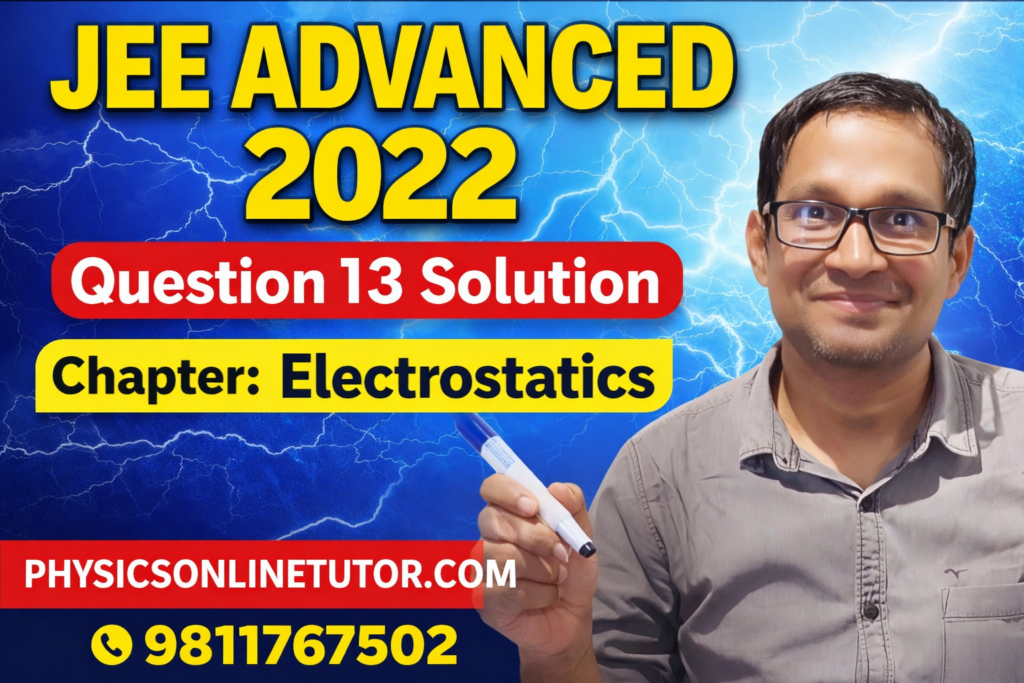
Understanding the JEE Advanced 2022 Question 13 Solution
Introduction Securing a top rank in JEE Advanced requires more than just skimming through textbooks; it demands an analytical mindset and robust problem-solving abilities. Analyzing Previous Year Questions (PYQs) is one of the most effective strategies to build this aptitude. In this post, we’re breaking down a prime example: JEE Advanced 2022 Question 13 Solution, focusing on Electrostatics.
In this detailed analysis, we will focus specifically on the JEE Advanced 2022 Question 13 Solution to understand the nuances of electrostatic principles applied in this context.
The JEE Advanced 2022 Question 13 Solution requires a solid understanding of the underlying electrostatic concepts, which is crucial for any aspiring student.
This specific problem brilliantly showcases how core electrostatic concepts are woven into challenging, logical puzzles. By the end of this breakdown, you’ll not only grasp the solution to this specific problem but also unlock a framework for tackling similar high-level physics questions with confidence.
Why Electrostatics is a Game-Changer in JEE Electrostatics isn't just a standalone chapter; it's a foundational pillar of JEE Physics. Mastering it is non-negotiable because it sets the stage for understanding subsequent topics like capacitance, current electricity, and complex electrodynamics.
When the JEE Advanced examiners test electrostatics, they are evaluating:
- Absolute conceptual clarity
- The ability to apply advanced mathematical tools
- Multi-layered logical reasoning
- Spatial and vector visualization
Nailing this chapter is a proven way to secure high marks in the physics section.
Deconstructing the 2022 Electrostatics Problem Question 13 from the 2022 paper required students to seamlessly integrate several fundamental electrostatic principles:
- Coulomb’s Law
- Electric field intensities
- The Superposition Principle
The true hurdle of this question wasn’t the complex math, but rather the initial setup—identifying the correct conceptual pathway and applying vector logic in the precise order.
Let's delve deeper into the JEE Advanced 2022 Question 13 Solution to appreciate the intricacies of the problem.
A Blueprint for Solving Complex Physics Problems To solve this efficiently, we can break the approach down into five distinct phases:
- Step 1: Conceptualization First, isolate the core phenomenon. Is the question asking about a force, a field, or a potential difference? Here, the focus is on the intricate interaction between multiple point charges and their resulting net electric effects.
- Step 2: Formulation Select the correct mathematical models. Write down Coulomb’s Law for force or the standard electric field formulas. Carefully plug in the given parameters, paying strict attention to units and constants.
- Step 3: Vector Superposition When dealing with a system of charges, the principle of superposition is your best tool. Calculate the individual electric effect of each charge in isolation, then combine them vectorially. Note: This is where the most critical errors in direction and magnitude occur.
- Step 4: Mathematical Execution Simplify your equations systematically. Keep a close eye on sign conventions, trigonometric components, and vector directions to avoid losing marks to simple arithmetic mistakes.
- Step 5: The Sanity Check Before finalizing, review your answer. Do the units make sense? Is the resultant vector pointing in a logically sound direction?
Core Pillars Tested To conquer this problem, you need total mastery over:
- Coulomb’s Law: The baseline mechanics of how charges push and pull.
- Electric Fields: Visualizing and calculating fields generated by discrete charges.
- Superposition Principle: The art of merging multiple independent forces.
- Vector Algebra: Flawless resolution of components and resultant directions.
Once these pillars are solid, almost any challenging electrostatics question becomes approachable.
Pitfalls to Dodge Even well-prepared students can stumble under exam pressure. Watch out for these common traps:
- Failing to account for the exact direction of vector quantities (forces and fields).
- Making algebraic errors during vector addition.
- Applying an electric potential formula when an electric field formula was required.
- Rushing calculations instead of following a structured, step-by-step method.
Pro-Tips for Peak Performance To elevate your overall physics score, integrate these strategies into your routine:
- Analyze PYQs Deeply: Don't just solve them; understand the examiner's intent.
- Expand Your Horizons: Supplement standard material with advanced aptitude-testing physics problems to sharpen your analytical edge.
- Prioritize Concepts Over Rote Learning: Physics is about understanding the "why" behind the formulas.
- Simulate Exam Conditions: Take timed mock tests to build mental stamina.
- Audit Your Errors: Review every mistake to ensure you never make it twice.
The Value of This Specific PYQ Why spend so much time on Question 13? Because it perfectly encapsulates the JEE Advanced ethos. It tests bedrock fundamentals while demanding the fusion of multiple concepts simultaneously. Practicing at this tier builds the exact type of analytical muscle memory needed for exam day.
Final Thoughts Working through a problem like JEE Advanced 2022 Question 13 is about more than finding the right option—it’s about refining your problem-solving architecture. Focus on the underlying concepts, avoid jumping to shortcuts, and systematically build your foundation.
This section will outline the critical components of the JEE Advanced 2022 Question 13 Solution and highlight its importance in the overall exam strategy.
Ready to Master Physics? For rigorous, concept-driven guidance and detailed solutions tailored for top-tier competitive exams:
🌐 Visit: physicsonlinetutor.com
📞 Call/WhatsApp: 9811767502