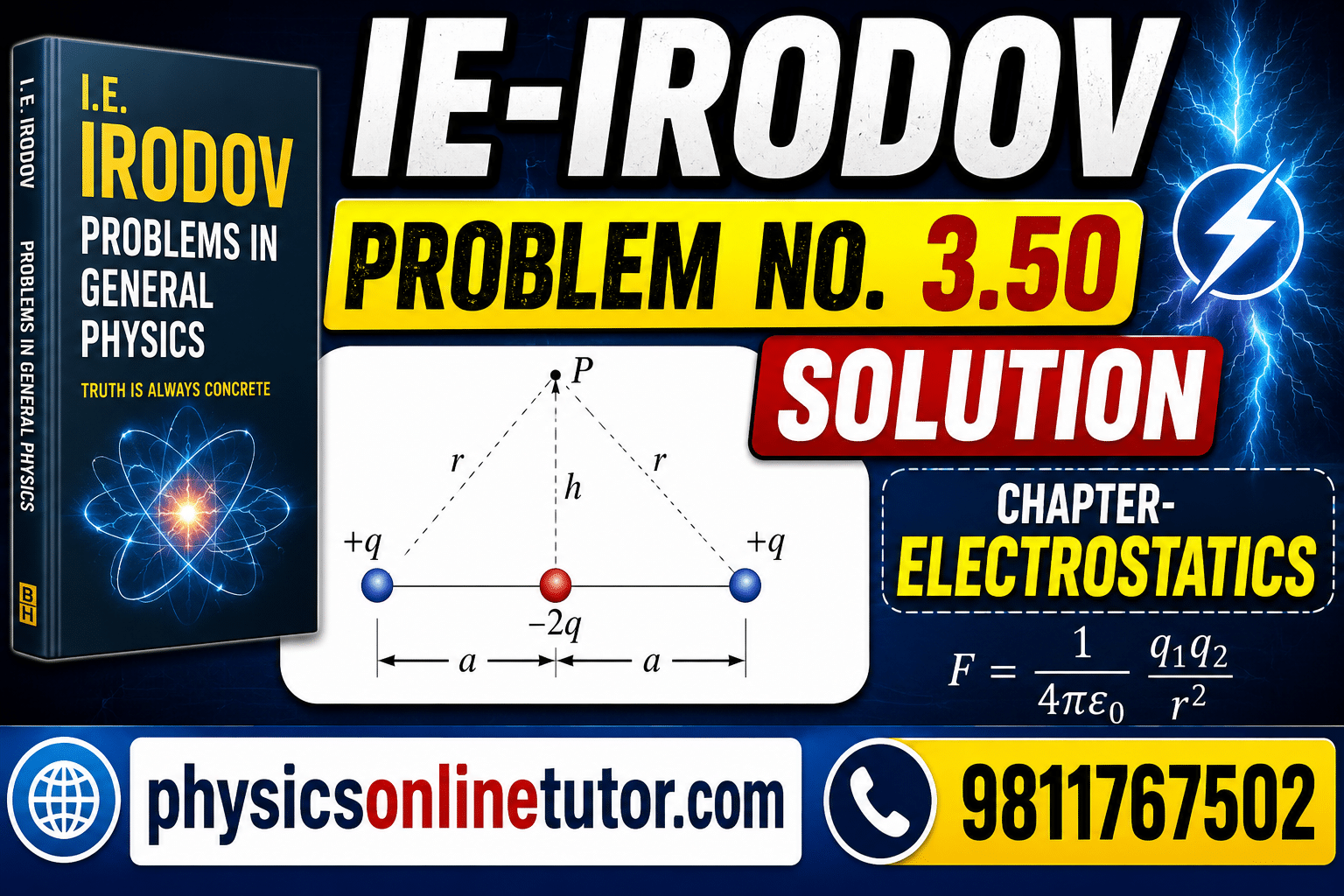

Introduction to the Problem In Problem 3.50 of I.E. Irodov, the arrangement of charges is given symmetrically, and we need to calculate the electric interaction at a specific point. Such problems test a student’s ability to apply electrostatic principles carefully and use symmetry effectively. The problem generally involves: Point charges Coulomb’s law Vector addition of electric fields or forces Geometrical relationships These concepts are extremely important for mastering electrostatics. Concept Used in the Problem Before solving the problem, let us revise the main concept used. Coulomb’s Law F= 4πε 0 1 r 2 q 1 q 2 According to Coulomb’s law, the force between two point charges is directly proportional to the product of the charges and inversely proportional to the square of the distance between them. Where: q 1 and q 2 are the charges r is the distance between them ε 0 is the permittivity of free space Understanding the Geometry The geometry of the problem plays a major role in simplifying the calculations. In many Irodov electrostatics problems, symmetry allows us to cancel horizontal components or simplify vector addition. Suppose two positive charges are placed symmetrically and another charge is placed between them. The electric field or force at the observation point can be determined by calculating contributions from each charge separately. Using symmetry: Horizontal components may cancel Vertical components may add Net force becomes easier to calculate This is one of the most important techniques in electrostatics numerical problems. Step-by-Step Solution Approach Step 1: Identify All Charges First, identify: Magnitude of each charge Nature of charge (positive or negative) Distance between charges Carefully draw the geometry diagram because electrostatic problems become much easier with a neat figure. Step 2: Apply Coulomb’s Law Use Coulomb’s law individually for each interacting pair. For example: E= 4πε 0 1 r 2 q This equation gives the electric field due to a point charge. Now calculate: Magnitude of electric field Direction of electric field Components along x-axis and y-axis Step 3: Resolve Components If the electric field makes an angle with the axis, resolve it into components: E x =Ecosθ,E y =Esinθ In symmetric configurations: Opposite horizontal components cancel Vertical components add together This greatly simplifies the numerical calculation. Step 4: Find Resultant Electric Field or Force Add all components carefully. If vertical components are in the same direction: E net =E 1 +E 2 If directions differ, use vector subtraction. Finally, write the magnitude and direction clearly. Important Learning from Irodov Problem 3.50 This problem teaches students: Proper use of Coulomb’s law Vector addition techniques Symmetry in electrostatics Geometrical interpretation of electric fields Efficient problem-solving methods for JEE Advanced Students often make mistakes in sign convention and vector direction. Therefore, always verify: Direction of electric field Sign of charges Component resolution Why I.E. Irodov Problems Are Important The book Problems in General Physics by I.E. Irodov is famous for developing deep conceptual understanding. These problems are widely used by: JEE Advanced aspirants Olympiad students Engineering students Physics enthusiasts Solving Irodov regularly improves: Analytical thinking Problem-solving speed Conceptual clarity Confidence in advanced physics Tips to Solve Electrostatics Problems Faster 1. Draw Proper Diagrams A clear diagram avoids confusion in directions and angles. 2. Use Symmetry Symmetry often reduces lengthy calculations. 3. Remember Standard Formulae Keep important electrostatics formulas memorized. 4. Practice Vector Resolution Most mistakes happen during component calculation. 5. Revise Concepts Regularly Electrostatics builds the foundation for current electricity and electromagnetism. Conclusion I.E. Irodov Problem No. 3.50 is an excellent electrostatics problem that strengthens your understanding of Coulomb’s law and electric field concepts. By carefully applying symmetry and vector addition, complex problems become manageable. Students preparing for JEE Advanced and other competitive exams should practice such problems regularly to improve conceptual understanding and calculation skills. For more detailed physics solutions, numerical discussions, and conceptual lectures, visit: 🌐 Physics Online Tutor 📞 9811767502 Stay connected for more I.E. Irodov solutions and advanced physics problem-solving tutorials.